Miscontinuity

Weekly comic book reviews from someone who's read them for too long and loves them too much.

Thursday, September 18, 2008

Spike: After the Fall #3 Review

Writer: Brian Lynch
Penciller: Franco Urru

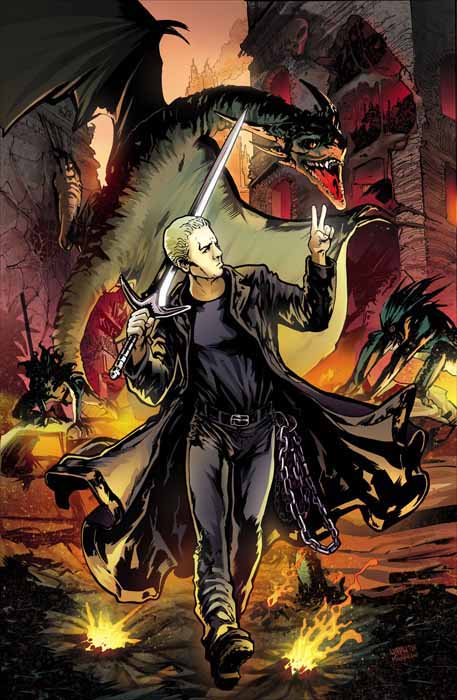
Something is missing in Spike: After the Fall #3. It has a lot of great elements to it. Spike seduces a captor. Gunn has an altercation with Non. Spike and Illyria kiss. There is fighting and chaos. Somehow, however, Spike seems to be missing from this comic. It is true that he is on most of the pages, but his usual wit and humour are missing. In the last issue of this series, Spike sizes up a dragon in the hopes of potentially killing it. Every possible strategem is attended by some sort of witty observation or sardonic remark. Lynch has shown in the first two issues that he is capable of capturing the speech patterns and personality of Spike, something which he hasn't had the space to do much of in the Angel: After the Fall series.

However, in this issue, all of that falls away. Take this piece of narration: "Also, she doesn't react well if someone, let's say a vampire, repeatedly yells to her to conure admittedly suggestive mirages to make the day go faster". That doesn't really sound like Spike. There's a little bit of humour in it, but it lacks any of the punch of Spike's usual observational humour. Spike's sense of humour is largely based on two things: he is very intelligent and he is very old. There is very little that he hasn't seen in his six or seven lifetimes, and he doesn't really know when to shut up (or at least doesn't bother). So, he makes comments constantly on what is going on around him, and has a tendency to see right through any of the pretenses around him. Part of what stops him from being simply mean and sarcastic is that he is wise enough not to actually hold people's pretences against them. These characteristics are what led him to fill in some of the role of Giles when Giles left Buffy in season six.

Most of that combination of pretense-popping humour and wisdom are absent in this issue, and it is weaker as a result. True, one might not expect Spike to be in quite such a good mood after being tortured for a month, but I can't think of any torture that would reduce Spike to pure exposition. There are a couple nice moments where we see some of Lynch's great ability to capture Spike's character: the fantasy at the beginning in which he is with Fred and Angel appears with a nametag saying, "Hello, my name is the reason we're stuck here" is great as is his making fun of Non as she goes off to her meeting with Gunn as though it will be some sort of date. However, that's really all we see. The last scene especially lacks Spike's usual sense of keen observation; it really could have been anyone.

Gunn, however, is written very well in this issue. He doesn't come across as quite as crazed as he did in the exceptional Angel: After the Fall #11, but we see what a monster he's become and more of the fate of the slayers from Angel is revealed here. It seems that he has turned them into vampires and is using them for fighting practice, or at least, that's the sense that I can make of why Non seems to kill them but they are alive again a few pages later. Moreover, we see his confused feelings for Fred come to the surface. Is he really just concerned about his prophecy? Or is he concerned about Fred? Remember, this is the same Gunn who murdered a man for Fred, and that was before he became a vampire. We see some of the same confusion in his character we've seen in other issues, and the fate of his slayers is truly creepy.

Overall, this isn't the strongest issue of Spike: After the Fall, and is on about par with the first issue. It has a few good moments, but somehow, Spike himself seemed to be missing. I assume this is just something of a misstep, and we'll see more of Lynch's style next month.

B-

Labels:

Thursday, August 7, 2008

Spike: After the Fall #2 Review

Writer: Brian Lynch
Penciller: Franco Urru

The first issue really set the stage for what has so far been a great series, Spike: After the Fall. The second issue picks up the action, and the comic has already found its own tone and sense of humour that renders this a great book and a real treat for Spike fans like me. I love Spike, dressed as him for three straight Hallowe'ens, and found him to be the best developed and written character on either the Buffy or Angel television shows. This story has the same mood as Spike: goofy, cynical but ultimately noble, and serves as a perfect vehicle for his character. Even though it is strictly a flashback in the Angel: After the Fall continuity, that doesn't stop Lynch from providing a story with its own plot, characters and suspense. We know that none of the main characters can get killed (and on Buffy and Angel, main characters do get killed), but the story still manages to produce the same kind of suspense we find in mainstream comics where the characters are equally immortal.

The story begins with a hilarious scene in which Angel's dragon decides to take Spike for a ride. Spike goes through a series of calculations about how he might kill the dragon, which serve both as a source of humour ("Thorn in paw. Look for a thorn in paw, pull it out, monster owes me and does my bidding. Might not have a thorn. Don't think they're called 'paws,' either") and as a reminder that Spike has two centuries of training as a fearless strategic fighter and killer. In the end, he decides to just threaten the dragon, which seems to work, and he flies off to Wolfram and Hart, where he encounters a strange tatooed man in a kind of fiery hell. After touching the man, he is incapacitated and leaves. This will serve as an important plot point later.

After that, he decides to rescue his and Illyria's flock from a group of female demons that have captured them. They are well drawn, both literally and dramatically, and the boss lady, Non, seems to have the same sense of humor as Spike. She calls the human beings "shells", which is reminiscent of what Illyria called Fred after she killed her, making me think that there may be some connection to the old ones, the original demons. Spike arrives and attempts a valiant rescue, which fails miserably after he and Illyria are captured and all of his flock (except Jerry, who I'm pretty sure is evil) are turned into zombies. Normally, seeing a few dozen people murdered would be shocking, but the last issue of Angel: After the Fall revealed that the people in hell may very well be illusions, so until that is sorted out, there isn't much horror attached to the killing of civilians.

Non isn't interested in killing Spike or Illyria, but is after their power. It seems that the tatooed man whom Spike touched at the beginning of the issue had filled him with a great deal of power, and Non wants it. This turns Non from a generic demon to a real threat. She's clearly after something very dangerous and I look forward to seeing where this plot is taken. A lot of clever, mysterious villains are being developed, well suited to the characters of Spike and Illyria, and I am really enjoying watching this well-crafted book establish its independence from the main title.

B+

Labels:

Wednesday, July 16, 2008

Spike: After the Fall #1 Review

Writer: Brian Lynch
Penciler: Franco Urru

After ten months of reading about his sidekick, Angel, we finally have a story about the main man himself, Spike. This book is about the experience of Spike right after he and the rest of L.A. are sent to hell at the end of the television series, Angel.

The book is a mixture of good and bad elements. On the positive side, Spike finally finds his voice. While Spike has been a character in Angel: After the Fall since the first issue, he's never really sounded like Spike and has never really been a focus of attention. In this book, Lynch shows that he really understands how to write Spike. His sardonic humour and wit come across perfectly, and he has the ability to make jokes even in the face of horror. He is like one of those very intelligent people who make clever and witty comments at the most inappropriate times, because they can't think of anything stupid to say.

The story is a lot of fun, and catches up with Spike right after the trip to hell. He and Illyria lead a group of refugees in a former amusment park, which is the source of a great deal of humour in itself. Illyria is busy smashing the park, since she is apparently wounded in her Fred form, and the rides make her angry enough to change back. The backdrop of an amusement park is a perfect location for Spike and Lynch to let their absurd sides out, as they are unlikely to upstage their surroundings.

On the other hand, Spike: After the Fall makes the same mistake as the main series. The main draw of both Buffy: Season Eight and Angel: After the Fall is that we want to catch up with the main characters and see what happens to them. Telling stories about what happened in high school or before Wolfram and Hart never sold very well. However, the After the Fall stories have now spent almost half their time telling us stories that are now in the past, not progressing the stories any further.

Unfortunately, it looks like this might be the case for the entirety of the Spike series. I don't understand why Lynch believes that he cannot simply tell a story about Spike that runs concurrently with the main story, and turns the entire series into a flashback. There's little here we didn't already know: Spike and Illyria are working together and she is turning periodically into Fred. Lynch is dangerously close to having less development in his stories than Bendis.

The art is also a bit jarring. We met these characters as live-action characters, and they look especially cartoon-like in this story. The edges of the characters are drawn very thickly and sometimes they seem more like shapes than people. However, the art is good and I'm sure with time it will grow on me, but it is worth noting that this book is not attempting, like Buffy: Season Eight, to mimic the faces of the actors.

Nonetheless, it is nice to see some focus on Spike and it refreshing to catch up with someone who feels like an old friend. The subplot of the possibly evil Jerry/Jeremy is interesting. It's nice to see Fred back, even if she is a bit confused, and the ending, in which the people at the amusement park are happy to be conquered because they are so bored is hilarious. This is an entertaining book and a worthwhile read.

B-

Labels: