Miscontinuity

Weekly comic book reviews from someone who's read them for too long and loves them too much.

Thursday, September 4, 2008

Buffy: Season Eight #18 Review

Writer: Joss Whedon
Penciller: Karl Moline

Spoiler Alert

With its third part, the episode "The Time of your Life" is finally starting to come together. What is most interesting about this comic is that Joss Whedon has quite successfully merged his comic book, Fray, with the Buffy universe at large. Several elements are coming together here. At the end of Season Seven, Buffy turned all potential slayers into true slayers, thus changing the world. Moreover, by doing so, she changed her own fate, or rather, removed it. Buffy had been the "one girl, in all the world, a chosen One. One born with the strength and skill to hunt the vampires, to stop the spread of evil". By imbuing the other potential slayers with her power, she removed her own destiny. The final line of the television show was Dawn asking Buffy, "Yeah, Buffy, what are we going to do now?". Buffy lets out a small smile, indicating that, for the first time since she was called to be the Slayer, she was able to ask herself that question.

The importance of the current story line is that it appears, somehow, that Buffy failed. In Fray's future, there is only one slayer again. Most fans had assumed that Fray was simply out of continuity, and because it was published before the final episode was aired, it had just not taken the finale of the series into account. Either Joss Whedon knew what he was planning all along, or he made it seem like he did. Instead, the existence of Fray indicates that somehow Buffy failed, and quickly. All the history books that Buffy reads at the beginning of Issue #18 include no mention of her army of slayers, indicating that her army was either wiped out or depowered before anyone could even notice.

How did all of this happen? Curiously, this issue indicates that somehow Buffy is probably responsible. The Willow of the future claims to have very little magic power left, which may or may not be true. Moreover, whatever she told Fray about Buffy convinced Fray that Buffy needed to be killed or at least captured. The Willow of the future is also apparently conspiring to bring someone back into the past, possibly to change whatever would happen, so that magic will not be eliminated from the world. Either Buffy will lose to this group, Twilight, or somehow she imbalanced magic enough that it will somehow be destroyed.

We are beginning to see some of the complexities of the themes of this season. Buffy has created an entire army of slayers, and humanity has simply had enough. We have seen humanity try to fight magic before, with the disastrous Initiative from season four. Twilight is humanity's response to the continuing threat from magic and from the fairly tale world that continues to press against its borders. One curious thing about the themes of this season is that it's not entirely clear who is in the right. Sure, Twilight is creepy, but when presented with the possibility that humanity might be out to stop magic, Buffy's response is to simply say, "Bring them on".

There is an interesting character moment in which we realise Buffy may have lost her compass. When she and Fray are watching vampires attack a group of citizens, Buffy doesn't leap into battle, but instead plans to watch them kill the humans so they can follow them back to their base. At first, I tried to rationalise this scene, thinking that perhaps Buffy was about to discuss a plan in which Fray stops the vampires while she follows the driver back to their base, but I'm not so sure. This is a new Buffy, not the one who foolishly ran off to save innocent civilians while Drusilla killed Kendra and put Willow in the hospital, falling for the same ruse "every single time!" as Angelus mocked. Looking carefully over the season, there have been a few moments where Buffy's utilitarian reasoning has arisen. She has been robbing banks in order to finance her army. She has put some of her soldiers into jeopardy by turning them into her decoys, one of whom was killed. This issue, she is content to simply watch people die for the greater good. Her reasoning has started to resemble some of the darker reasoning of the Watchers during the television show, which makes sense given that this has basically become her role relative to the newer slayers. Future Willow may not have needed to invent very much in order to turn Fray against Buffy.

As a whole, then, the arc of this story is very impressive. It is good to see this comic turn from a series of interesting events to a genuine story with important themes that Whedon wants to tell. In its particular moments, some of the scenes are very funny. Dawn's comment to Lorelahn is laugh-out-loud funny when she asks him whether or not he was caught in a "legend blender". The face-off between Harth and Gunther is suitably creepy, as the two of them realise that they are in a stalemate, and Gunther shows Harth that maybe he isn't the biggest creep in town. The future Willow is starting to be developed well, and she is not the dark Willow of season six nor the vampire Willow of season three. Instead, she is simply a sad figure, almost like a repository of dark and mostly forgotten memories. She looks like an old, broken doll, with cracks on her porcelain forehead and in a tattered, dirty dress. Her comment that she "earned" her title as "madwoman" indicates that somehow she may be responsible for her own misery.

This is the best issue yet of the series, even though nothing much happens in it. Instead, Whedon is carefully drawing out his themes and subtly tying together his narrative, leaving the reader to realise that something very, very bad is about to happen, and that it might be the fault of our favourite characters.

A-

Labels: ,

Monday, August 11, 2008

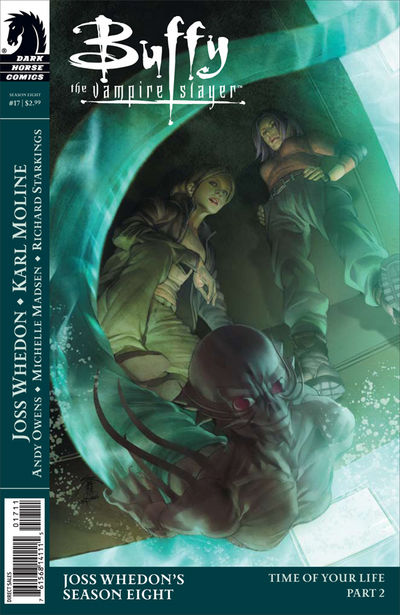
Buffy the Vampire Slayer: Season Eight #17 Review

Writer: Joss Whedon
Penciller: Karl Moline

*Spoilers* (Buffy fans have somewhat stricter rules about spoiler warnings)

This review is late for this week, as reading this comic required a lot of homework on my part. Joss Whedon has made an interesting decision: he integrated his comic character Fray (from a story five years ago) into the Season Eight story line. Since I had never read "Fray" but my wife had a copy of the book, I wanted to read the storyline before I read this issue. After having read "Fray" I realised that, in fact, this book would be almost completely unreadable without having read the previous series.

I'm not sure how good an idea this is. It will sell "Fray" comics, which is a good thing, though I don't think that a purely marketing decision would have gotten past Joss Whedon. Season Eight is an interesting comic book, since it is one of the few comic books that does not have comic book readers as its target audience. A lot of the people reading this book are former fans of the Buffy television show who mourn its passing and want to read about the further adventures of their favourite characters. And so far, the story has been almost entirely self-contained, just like most television shows are. Even the five-year-long spin-off Angel was never "required reading" for watching Buffy (although not vice versa). As with most television shows, someone could watch the show and never need to "catch up".

Is this a good decision, then? It has some negative and positive elements. On the negative side, it risks alienating the audience that is unique to this comic. I don't know how many Buffy fans will be interested in reading Fray and this comic is truly unreadable without it. When Fray talks about the past, if one hasn't read Fray, it would be unclear what happened in her own series and what was supposed to have happened two-hundred years ago, since she rarely makes such distinctions. For example, from the two pages I read before giving up, I had assumed the "Battle of Starbucks" was something that happened in the Fray comic, but apparently it happened centuries ago. On the positive side, it might introduce people who would not otherwise be interested in comics and would not have read any comics if not for the Season Eight series to a new medium. Some people might read Fray, enjoy it, and become comic book fans for life. We shall see. I'm interested to follow the sales number of Season Eight after this issue, as I think no single issue will have more effect than this one.

As for the plot, the big reveal in this comic is a little unfulfilling. The issue spends a great deal of effort hinting that the crazy woman in Victorian clothes at the end is Drusilla, but it turns out to be another incarnation of Dark Willow. Am I the only one who was disappointed by this? Drusilla vanished half way through Buffy Season Five never to be seen again except in flashbacks and as a ruse for the First Evil. I kind of miss her. Dark Willow, on the other hand, dominated much of Season Six which was a season of mixed success as it was. I don't miss her. It's fun when Willow's eyes turn black from time to time, but I thought this plot point was resolved with the whole "Willow turns white and is therefore a goddess" scene in the series finale. Now, we're returning to it. I'm not saying that Whedon doesn't have any good ideas about where to take this; he usually does. However, as a big, shocking finale, it doesn't really work because it's an old plot point and not one the fans have really been clamoring for. Moreover, the red herring covering it is something the fans have been clamoring for, so it falls flat.

Despite these general arc concerns, Issue #17 works very well. Joss Whedon is a great banter writer, as good in his own way as Tarantino. The dialogue comes off as both funny and realistic, capturing the way that people are often trying to amuse each other in discussions. Most other authors write dialogue that is either expository, dramatic or "funny". What Whedon has hit onto and few other have is that we are constantly telling jokes, but those jokes are so contextual they can never be taken out of their original place in conversation. Little bits of dialogue like "Buffy Summers." - "Present." - "Buffy Summers is dead." - "Occasionally.", capture very well the way that we are often making little jokes out of what the other person has said, and I can't think of any other writer that mimics this or even tries. The closest analogue is Bendis, but what he provides isn't so much banter as little jokey asides people (especially Spider-Man) say to themselves. Whedon is able to implant that contextual humor into dialogue in a way that is truly unique. This book is full of contextual humour, and it is wonderful to see Whedon writing characters whose voices he understand perfectly as he was the one to create them.

The Fray universe is utilized very well, and one gets the sense that Fray has been fighting her brother for quite some time now. She is still tracking down her brother Harth, who is now working with Dark Willow to bring about a future without any magic (except, presumably, Willow). One annoying thing about Fray was that it seemed to contradict the finale of the television series, as there was only one slayer again, rather than an army, and that the Watchers had "died out" rather than getting blown to bits as in the series. This book does a good job of reconciling them, so well in fact that it is impossible to tell whether this is a retcon or whether this was Whedon's plan all along. Instead, the death of magic referred to happens after Season Seven and is apparently the climax of Season Eight. Here we get a return to the Fray universe that is as strong and confident (even more so, in some ways) as Season Eight's return to the Buffyverse in the first place. Gunther, Erin and Harth all return, and it is as though Whedon never left.

So, overall, it is a very strong book, even if it is at times harder to follow than a Grant Morrison comic. It is well written and Whedon's comfort with his characters is obvious.

B

Labels: